


The hardest game doesn’t end with the final whistle. It begins when no one’s keeping score.
☀️What’s up y’all! Draps here.
I co-write The Inner Rink — a weekly practice about the psychology of performance, discipline, and greatness, on and off the ice.
I’m a pro hockey player turned writer and mentor — here to be the guy I wish I had when I was chasing the dream.
For most of my life, I knew who I was the moment I woke up.
I was an athlete.
My day had structure.
My effort had direction.
My identity had edges.
And then one day, the game ended.
Not with a dramatic final shift or a moment everyone clapped for.
Just a quiet transition into adulthood, where no one asked about my game anymore and no one handed me a new jersey to step into.
That is when the question showed up. The one no one prepares you for.
Who am I now that I’m no longer a hockey player?
If you are reading this and that question feels familiar, this practice is for you.
The post-game identity shift is one of the hardest transitions every elite level athlete faces.
When the structure that once held you disappears, the schedule fades, the role shifts, or the game goes quiet- The Story You Tell Yourself becomes everything.
The Post Game Playbook isn’t about becoming someone new.
It’s about stabilizing who you already are, separating worth from role, and giving your competitive drive a new place to live.
Let’s begin.
The Post-Game Playbook is not motivation or about “finding your passion.”
It’s a practice for the moments when the structure that once held your identity disappears.
What breaks most athletes after the game isn’t the loss of competition. It’s about the moment the structure fades, the rink goes quiet and the jersey comes off.
The moments no one is telling you where to be, what time to show up, or what your role is.
Sometimes that happens at the end of a career.
Sometimes it happens in an offseason.
Sometimes it happens after an injury, a scratch, a trade, or a role change.
But eventually, every athlete faces the same post-game moment and most players are never taught how to handle it.
Jessica’s Perspective- From The Nervous System
Most post-game advice skips the nervous system.
When structure disappears, the nervous system loses its regulator and without stabilization, the brain stays in survival mode(scanning, bracing, reacting).
Athletes don’t struggle after sport because they lack resilience.
They struggle because sport shaped their identity, nervous system, and reward circuitry for years. Often decades.
Here’s what is actually happening beneath the surface:
Your identity was externally reinforced through performance, role, and contribution.
Your nervous system was regulated by structure such as schedules, feedback, and recovery cycles.
Your dopamine system was calibrated to competition through wins, losses, progression, and purpose.
When the game ends, those systems don’t gently adjust. They go quiet.
That quiet can feel like emptiness, restlessness, anxiety, irritability, grief, or a vague sense that you have lost yourself.
This isn’t weakness.
It’s a neurobiological identity gap and it can be rebuilt with the right approach.
THE POST-GAME IDENTITY RESET
Three Steps to Reclaim Your Identity
This isn’t about becoming someone new. It’s about stabilizing who you already are, separating worth from role, and giving your competitive drive a new place to live.
1. Stabilize The Athlete Identity
(AFFIRM:“I am still someone, even without the game.”)
The biggest mistake athletes make after sport is rushing to replace their identity.
A new career.
A new mission.
A new label.
Standing still feels unbearable so you grab onto anything.
But identity doesn’t grow on unstable ground.
When structure disappears, the nervous system interprets uncertainty as a threat; not danger, but disorientation.
Before you decide what’s next, your system needs stability.
The work here is simple:
Anchor into traits that were never dependent on a scoreboard. Transferable skills such as:
Discipline
Consistency
Adaptability
Leadership
Resilience
Learning capacity
These didn’t retire when you did.
Drill:
Ask yourself:
If the game never existed, what parts of me would still be true?
Write capabilities.
Not titles.
2. Separate Worth From Role
(AFFIRM:“What I did is not who I am.”)
This is the hardest step.
For years, worth and performance ran together.
A good game meant confidence.
A bad game meant doubt.
When the role disappears, worth feels like it disappears with it.
This isn’t ego. It’s conditioning.
Performance-based systems train the brain to equate output with value.
When output stops, the brain registers loss of status.
That’s why post-game life feels heavy.
The work here isn’t rejection, it’s relief.
Reframe this:
My sport expressed my identity. It did not define it.
Then ask:
Who was I being when I was at my best?
What did people trust me with under pressure?
What qualities showed up consistently?
Those qualities didn’t retire.
They’re still yours.
3. Redirect The Competitive Energy
(“Where does this fire belong now?”)
Athletes don’t lose their drive after the game.
They lose a place to put it.
Unused competitive energy turns inward and shows up as:
frustration
self-criticism
restlessness
chasing intensity without meaning
The mind doesn’t need another sport.
It needs:
progression
challenge
feedback
contribution
In other words; a new arena.
This step isn’t about deciding your life’s purpose.
It’s about giving your drive somewhere to move.
Start small:
mentor someone
build something measurable
train your body with a new goal
learn a skill with structure
contribute where effort matters
For me, this was when competition softened into leadership.
The fire didn’t disappear.
It evolved.
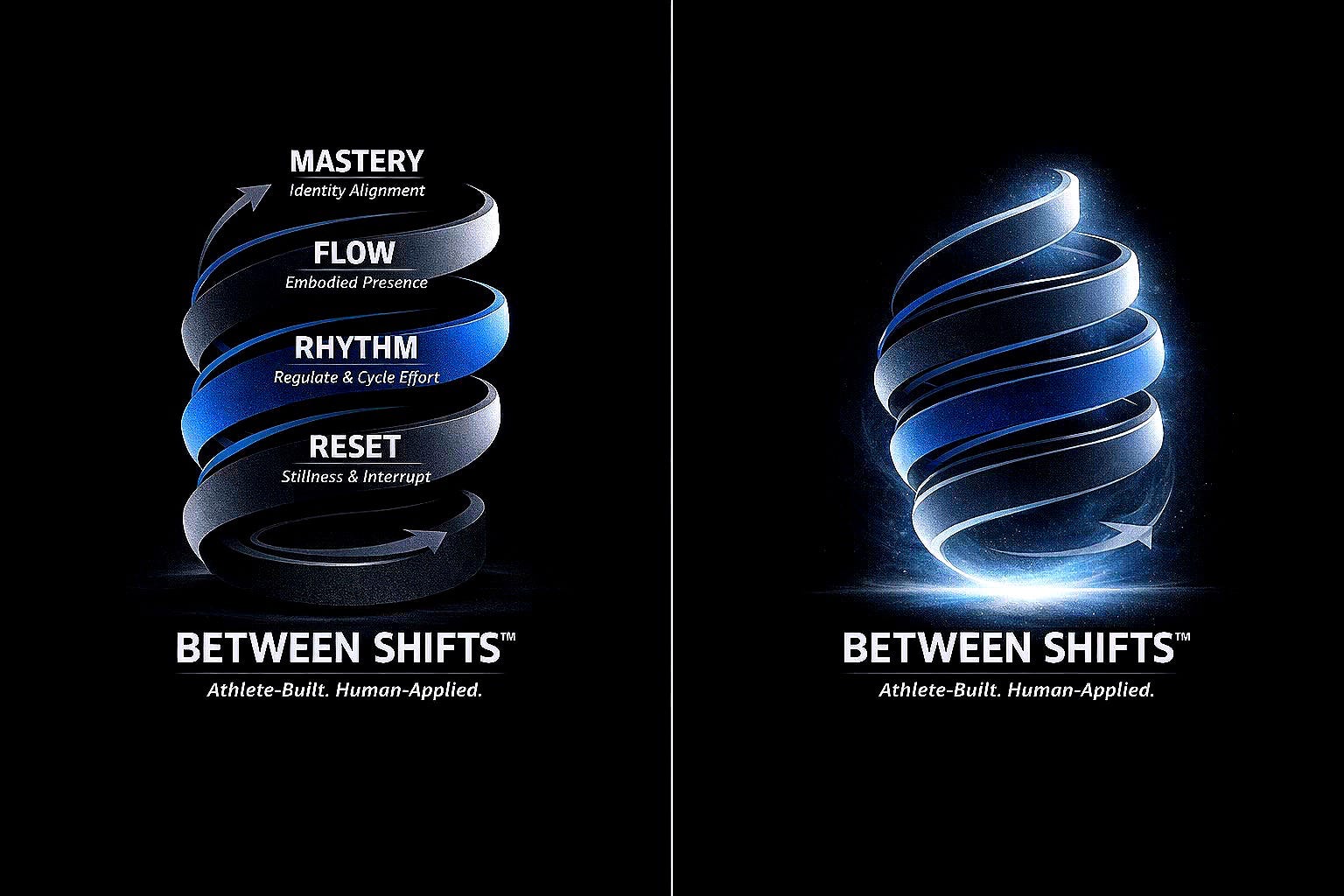
Beyond The Rink
This phase is not an ending. It’s Between Shifts.
It’s a reorganization of identity.
You are learning how to be disciplined without being defined, driven without being consumed, and competitive without constant validation.
This practice isn’t just for athletes leaving the game.
It applies anytime structure fades:
offseason
injury
career shifts
relationship endings
identity transitions
Life has post-game moments too.
This playbook teaches you how to move through them
without losing yourself.
🧠Reader Reflection
Where in your life has structure recently faded?
Not permanently — just enough to feel unsteady.
What part of you is trying to rush forward
before stabilizing who you already are?
That’s the place this practice applies.

Final Thoughts
The freedom was never the problem. The lack of structure was. Athletes aren’t built to drift. We’re built to move with edges. When the jersey comes off the game doesn’t disappear, it changes scale.
The post-game moment isn’t about reinvention.
It’s about stabilization.
Identity before direction.
Structure before purpose.
This isn’t the end of who you were.
It’s the beginning of who you are without needing the scoreboard to prove it.
Thank yourself for showing up today. I’ll see you next time.
—Joe Drapluk
The guy I wish I had when I was chasing the dream.

A Letter to The Former Athlete
“You did not lose yourself.
You outgrew a version of you that was held together by schedules, jerseys, and scoreboards.
That version mattered.
It shaped you.
It deserves respect.
But it was never meant to be the only place your identity lived.
You are not late.
You are not behind.
You are not failing at life.
You are in transition, and that is a skill too.
With patience, structure, and honesty, this can become the most grounded chapter you have ever lived.
You are still you.
Just learning how to exist beyond the rink.
That is the Inner Rink. Even now.”

🥅 Thank You for Being Here & If You Want to Go Deeper
If this hit you, consider joining The Captain’s Circle—a private space for athletes, former players, and high performers who are ready to:
rewrite their Inner Rink story.
build identity that outlasts the game.
train their mind with the same discipline they trained their body,
Inside, we break down frameworks, stories, and mental systems to help you become someone who doesn’t just play the game—You make it. As a PlayerMaker and part of The Inner Rink team.
🐐Recent Articles
The Story You Tell Yourself

You don’t play like the player you are. You play like the player you believe you are.”
🧊The Shift No One Sees

“The mind is where the real shift happens long before your skates ever touch the ice.”
Welcome to The Inner Rink: The Mental Game No One Teaches You

“This ability to conquer oneself is no doubt the most precious of all things sports bestows on us.”
DISCLAIMER
The Inner Rink shares educational content for athletes and readers interested in performance psychology, mindset, and discipline. It is not intended as medical, psychological, or therapeutic advice or to take the place of such advice or treatment from a personal physician. Always seek guidance from a qualified health care professional regarding your specific questions and individual situation.
I have outlined careers related to football which is a great look at what can be done in the world of sports after injury or retirement or for anyone who loves sports and wants to work in that world. spoets crosses all disciplines https://substack.com/@careervisionbyjamie/note/c-211843009?r=22h7tg&utm_medium=ios&utm_source=notes-share-action
Love all of this! As Athletes we don’t forget how to drive when we leave sport but we often times lose the structure we had and don’t understand the “new arena” we are in. And that can make all the difference. Such an important conversation. Thanks for posting.